Showing posts with label Question 29. Show all posts

Friday, November 9, 2018

9702/Oct Nov/13/2017/Q29

A beam of laser light is directed towards a narrow slit.

After emerging from the other side of the slit, the light then falls on a screen.
What is the pattern of light seen on the screen?


Solution:
Answer: B

The laser light will undergo diffraction after going through the narrow slit.

Please refer to this "Laser Diffraction and Interference" video for further understanding.


Reference: PYQ - Oct/Nov 2017 Paper 13 Q29

Thursday, November 8, 2018

9702/Oct Nov/12/2016/Q29

A microwave transmitter is placed at a fixed distance from a flat reflecting surface, as shown.

A microwave detector is moved steadily in a straight line from X to Y. A series of maxima and
minima of intensity is obtained. The distance between adjacent maxima is 1.5 cm.
What is the frequency of the microwave radiation?


A 1.0 × 10⁸Hz
B 2.0 × 10⁸Hz
C 1.0 × 10¹⁰Hz
D 2.0 × 10¹⁰Hz


Solution:
Answer: C

distance between adjacent maxima = λ /2

f = v/λ 
f = (3.0 x 10⁸ ms-1) / (2 x 1.5 x 10-2 m)

  = 1.0 x 10¹⁰ Hz

*To answer this question successfully, candidates needed to realise that the distance between intensity maxima in a stationary wave pattern is half the wavelength of the wave. Many candidates chose D because they thought that the measured distance was equal to the wavelength.

Reference: PYQ - Oct/Nov 2016 Paper 12 Q29

Tuesday, November 6, 2018

9702/May Jun/13/2015/Q29

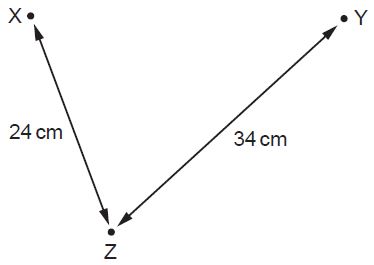
Wave generators at points X and Y produce water waves of the same wavelength. At point Z, the
waves from X have the same amplitude as the waves from Y. Distances XZ and YZ are as
shown.


When the wave generators operate in phase, the amplitude of oscillation at Z is zero.
What could be the wavelength of the waves?

A 2 cm
B 3 cm
C 4 cm
D 6 cm

Solution:
Answer: C.

The amplitude of oscillation at Z is zero, so destructive interference occurs at Z and the difference between lengths XZ and YZ must be an odd number of half-wavelengths.

Path difference between XY and YZ = 34 – 24 = 10cm
This path difference must be an odd number of half-wavelengths.

(n + ½) λ = 10cm
Wavelength λ = 10 / (n + 0.5)
Put n = 0, Wavelength λ = 10 / (0 + 0.5) = 20cm 
Put n = 1, Wavelength λ = 10 / (1 + 0.5) = 6.67cm
Put n = 2, Wavelength λ = 10 / (2 + 0.5) = 4cm [C is correct]
Put n = 3, Wavelength λ = 10 / (3 + 0.5) = 2.86cm
… 

Reference: PYQ - May/Jun 2015 Paper 13 Q29

Monday, November 5, 2018

9702/May Jun/11/2015/Q29

A loudspeaker emitting sound of frequency f is placed at the open end of a pipe of length l which
is closed at the other end. A standing wave is set up in the pipe.
A series of pipes are then set up with either one or two loudspeakers of frequency f. The pairs of
loudspeakers vibrate in phase with each other.
Which pipe contains a standing wave?

Solution:
Answer: D.

For a stationary wave (resonance) to be formed in the tube, there should be a node (zero amplitude) at the closed end and an antinode (maximum amplitude) at the open end or at the loudspeaker (which is at an open end).


Let’s assume that the frequency f produces the fundamental mode of vibration. Since the same frequency is used in all cases, the wavelength will be the same.

We are told that when the frequency is f, a stationary wave is formed in the pipe of length l. For the fundamental mode, the wave formed is a quarter of a wavelength.


λ / 4 = L          giving wavelength λ = 4L

The wavelength will be the same in all of the cases.


Consider choice A:
For a stationary wave, there should be an antinode at the loudspeaker and an antinode at the open end of the pipe. This corresponds to half a wavelength.


For this case, λ / 2 = L             giving wavelength λ = 2L

BUT from above, we know that the wavelength = 4L while the length of the pipe is only l.
Thus, this is not possible.

Consider choice B:
This is similar to choice A as there should be an antinode at both ends. This is also not possible.

Consider choice C:
Here, a node is formed at the closed end at an antinode at the loudspeaker. This corresponds to a quarter of a wave.


For this case, λ / 4 = 2L                      giving wavelength λ = 8L

This does not correspond to the wavelength (= 4L) obtained initially. Hence, this is not correct.

Consider choice D:
Here, an antinode should be at both ends for a stationary wave to be formed. This corresponds to a half a wavelength.


For this case, λ / 2 = 2L                      giving wavelength λ = 4L
 
This is the only case where the wavelength corresponds to the original case.

Reference: PYQ - May/Jun 2015 Paper 11 Q29