Showing posts with label Physical Quantities and Units. Show all posts

Monday, November 5, 2018

9702/May Jun/12/2015/Q4

The arrow represents the vector R.


Which diagram does not represent R as two perpendicular components?


Solution:
Answer: C.

When facing such types of question, it is best to tackle it by drawing on the question paper itself.

The vector sum of the two perpendicular components should provide a resultant equal to the vector R shown.
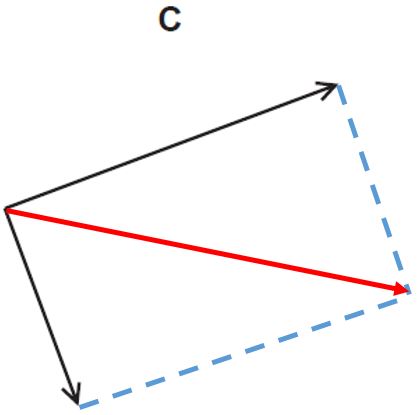

By completing the diagram (by the parallelogram method, for example), we can observe that only choice C does not provide a resultant similar to the vector R shown. Instead, the resultant in C has a downward direction and thus, cannot be equal to the vector R shown.

Reference: PYQ - May/Jun 2015 Paper 12 Q4

9702/May Jun/11/2015/Q3

When a constant braking force is applied to a vehicle moving at speed v, the distance moved by the vehicle in coming to rest is given by the expression
kv2
where is a constant.

When is measured in metres and is measured in metres per second, the constant has a value of k1.

What is the value of the constant when the distance is measured in metres, and the speed is measured in kilometres per hour?

0.0772 k1                       0.278 k1                         3.60 k1                            13.0 k1


Solution:
Answer: A.

d = kv2

When speed v is in ‘m/s’ and distance d is in ‘m’, the value of k is ‘k1’.
k1 = d / v2

We want to know the value of k when v is in ‘km/h’ and d in ‘m’.

Converting m/s to km/h
1 m/s means that in 1s - - -> 1m
1 h = 3600 s
1s - - -> 1m
1h - - > 3600 m = 3.6 km

Thus, 1 m/.s is equal to 3.6 km/h. Let the new value of speed = v2.
v2 = 3.6 v

New value of k = d / v22 = d / (3.6v)2 = (1 / 3.62) (d / v2)

But d / v2 = k1  

New value of k = (1 / 3.62) k1 = 0.0772 k1

Reference: PYQ - May/Jun 2015 Paper 11 Q3