Showing posts with label MJ2011/11. Show all posts

Thursday, November 8, 2018

9702/May Jun/11/2011/Q34

The resistance of a metal cube is measured by placing it between two parallel plates, as shown.

The cube has volume V and is made of a material with resistivity ρ. The connections to the cube
have negligible resistance.

Which expression gives the electrical resistance of the metal cube between X and Y?


Solution:
Answer: C

Resistance R of a wire = ρL / A
Where L is the length of the wire and A is the cross-sectional area of the wire.

For a cube, all the sides are of equal lengths. Let the length be L/
Volume V = L3
Length = L and cross-sectional area (in contact with the plates) = L2

Resistance R = ρL / L2 = ρ / L

But since V = L3, length L = V1/3
Resistance R = ρ / V1/3


Alternatively, if we consider the units of the quantities involved, only choice C gives the unit of resistance (Ω).
Unit of resistivity = Ωm
Unit of volume V = m3
Unit of ρ / V1/3 = [Ωm] / [m3]1/3 = [Ωm] / m = Ω 

Reference: PYQ - May/Jun 2011 Paper 11 Q34

9702/May Jun/11/2011/Q27

A diffraction grating with 500 lines per mm is used to observe diffraction of monochromatic light of
wavelength 600 nm.

The light is passed through a narrow slit and the grating is placed so that its lines are parallel to
the slit. Light passes through the slit and then the grating.


An observer views the slit through the grating at different angles, moving his head from X parallel
to the grating, through Y, opposite the slit, to Z parallel to the grating on the opposite side.
How many images of the slit does he see?
A 3
B 4
C 6
D 7

Solution:
Answer: D

For diffraction grating: d sinθ = nλ

The largest value of θ is 90° on both sides of Y. We need to identify the largest order n for which an image can be seen (constructive interference).

There are 500 lines in 1×10⁻³m.
Slit separation, d = (1×10⁻³) / 500 m

Value of n = d sinθ / λ = (1×10⁻³) (sin90°) / (500) (600×10-9) = 3.33

Since n can only be an integer, the largest order is n = 3. So, there are 3 images on both sides of Y. An image will also be seen at Y, which is directly along the source.

Number of images = 3 + 3 + 1 = 7

Reference: PYQ - May/Jun 2011 Paper 11 Q27

9702/May Jun/11/2011/Q5

The diagram shows an experiment to measure the speed of a small ball falling at constant speed
through a clear liquid in a glass tube.


There are two marks on the tube. The top mark is positioned at 115 ± 1 mm on the adjacent rule
and the lower mark at 385 ± 1 mm. The ball passes the top mark at 1.50 ± 0.02 s and passes the
lower mark at 3.50 ± 0.02 s.

The constant speed of the ball is calculated by (385 – 115) / (3.50 – 1.50) = 270 / 2.00 = 135 mms-1.

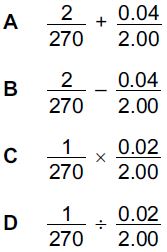
Which expression calculates fractional uncertainty in the value of this speed?


Solution:
Answer: A

Speed v = Distance s / Time t
Δv / v = (Δs / s) + (Δt / t)

Fractional uncertainty of speed = Δv / v

Distance s = 385 – 115 = 270 mm
Δs = ± (1 + 1) = ± 2 mm

Time t = 3.50 – 1.50 = 2.00s
Δt = ± (0.02 + 0.02) = ± 0.04 s

Reference: PYQ - May/Jun 2011 Paper 11 Q5