Showing posts with label Wave. Show all posts

Wednesday, November 14, 2018

9702/Oct Nov/12/2016/Q24

A transverse progressive wave of wavelength λ is set up on a stretched string. The graph shows
the variation of displacement y with distance x at a particular instant of time. The displacement
where distance x = λ/8 is y1.


What are the next two values of x where the displacement y is again equal to y1?


Solution:
Answer: B

From the figure above, it is very obvious the option C and D are incorrect.

The answer is "B" is because the second value of x must more than λ.

Reference: PYQ - Oct/Nov 2016 Paper 12 Q24


Monday, November 12, 2018

9702/Oct Nov/13/2017/Q22

The graph shows how the displacement of a particle in a wave varies with time.


Which statement is correct?
A The wave has a period of 2 s and could be either transverse or longitudinal.
B The wave has a period of 2 s and must be transverse.
C The wave has a period of 4 s and could be either transverse or longitudinal.
D The wave has a period of 4 s and must be transverse.

Solution:
Answer: C

The period of the wave is 4s, so option A and B are incorrect.

The wave could be either transverse or longitudinal because the graph is not represent the actual shape of the longitudinal wave. Because the graph is only represent the displacement of the wave during specific time.


Reference: PYQ - Oct/Nov 2017 Paper 13 Q22

Friday, November 9, 2018

9702/May Jun/12/2015/Q24

Two light waves of the same frequency are represented by the diagram.


What could be the phase difference between the two waves?

A 150°
B 220°
C 260°
D 330°

Solution:
Answer: C

The 2 light waves are said to have the same frequency. The waves have a sinusoidal form.

Let the wave with the larger amplitude be wave A and the one with smaller amplitude be wave B.

Since both waves have a sinusoidal form, we can assume that any of the 2 waves will start at displacement = 0 (we take this point as the reference point), and then move up – just like the wave A at (0, 0).
{In fact, any point (at any displacement) could be taken as the reference point, but in this question, it is easier to consider that point.}


On the graph, the x-axis gives the phase angle.
At a phase of 0°, wave B has not yet reaching the starting (reference) point while wave A is already at that point. It is only at a phase of 100° that wave B reached the reference point (or we could say that wave B reaches this point AGAIN at 100°).

The solution of 100° is not available in the 4 choices, so we can say that wave B had actually already reached this point before – we need to find at which phase this was, according to the x-axis in the diagram.

The phase angle is actually between 0° and 359°. A phase difference of 360° is the same as a phase difference of 0° and a phase difference of 1° is the same as a phase difference of 361°, ….

The wavelength of a wave corresponds to a phase difference of 360°. Since the 2 light waves have the same frequency, it means that they are the same wavelength.

So, if wave B reached the reference point again at a phase of 100°, according to the x-axis, going back by a wavelength (by a phase difference of 360°), we can say that previously, wave B had reached the reference point at the phase of
Phase = 100 – 360 = – 260°

As for wave A, it reaches the reference point at a phase of 0° (according to the x-axis).

Thus, phase difference between wave A and B = 0 – (–260) = 260°

Reference: PYQ - May/Jun 2015 Paper 12 Q24

9702/Oct Nov/13/2017/Q25

A source of sound of frequency F at point Z is moving at a steady speed. The pattern of the
emitted wavefronts is shown.


Which row describes the frequencies of the sound heard by stationary observers at X and Y?


Solution:
Answer: C

Let v be the speed of sound in air. A source of sound has a frequency F and wavelength λ. The source moves towards an observer at a speed vs.
The period of oscillation of the source of sound is T (= 1/F). In the time of one oscillation the source moves towards the observer X a distance vsTHence the wavelength is shortened by this distance. The wavelength of the sound received by the observer is λ − vsT.
Hence the frequency observed fo = v / (λ vT)
                                         = v / [(v/F)-(vs / F) ]
                                         = (Fv/(v-vs))
The source would move away from a stationary observer at position Y on the right-hand side. The observed wavelengths would lengthen.

For a source of sound moving away from an observer the observed frequency can be shown to be           fo = Fv/(v + vs)

*The frequency is increased when the source moves towards the observer and the frequency is decreased when the source moves away from the observer.

Reference: PYQ - Oct/Nov 2017 Paper 13 Q25

9702/Oct Nov/13/2017/Q29

A beam of laser light is directed towards a narrow slit.

After emerging from the other side of the slit, the light then falls on a screen.
What is the pattern of light seen on the screen?


Solution:
Answer: B

The laser light will undergo diffraction after going through the narrow slit.

Please refer to this "Laser Diffraction and Interference" video for further understanding.


Reference: PYQ - Oct/Nov 2017 Paper 13 Q29

9702/Oct Nov/13/2017/Q28

An electromagnetic wave travels in a straight line through a vacuum. The wave has a frequency
of 6.0 THz.

What is the number of wavelengths in a distance of 1.0 m along the wave?


A             5.0 × 10⁻⁵
B             2.0 × 101
C             2.0 × 10⁴
D             5.0 × 10⁷


Solution:
Answer: C


λ = v/f
= (3.0 x 10⁸ ms-1)/ (6.0 x 10¹² s-1)
= 5.0 x 10⁻⁵ m

No. of λ = 1.0m/ (5.0 x 10⁻⁵ m)
= 20 000

= 2.0 x 10⁴

Reference: PYQ - Oct/Nov 2017 Paper 13 Q28

Thursday, November 8, 2018

9702/May Jun/11/2011/Q27

A diffraction grating with 500 lines per mm is used to observe diffraction of monochromatic light of
wavelength 600 nm.

The light is passed through a narrow slit and the grating is placed so that its lines are parallel to
the slit. Light passes through the slit and then the grating.


An observer views the slit through the grating at different angles, moving his head from X parallel
to the grating, through Y, opposite the slit, to Z parallel to the grating on the opposite side.
How many images of the slit does he see?
A 3
B 4
C 6
D 7

Solution:
Answer: D

For diffraction grating: d sinθ = nλ

The largest value of θ is 90° on both sides of Y. We need to identify the largest order n for which an image can be seen (constructive interference).

There are 500 lines in 1×10⁻³m.
Slit separation, d = (1×10⁻³) / 500 m

Value of n = d sinθ / λ = (1×10⁻³) (sin90°) / (500) (600×10-9) = 3.33

Since n can only be an integer, the largest order is n = 3. So, there are 3 images on both sides of Y. An image will also be seen at Y, which is directly along the source.

Number of images = 3 + 3 + 1 = 7

Reference: PYQ - May/Jun 2011 Paper 11 Q27

Wednesday, November 7, 2018

9702/May Jun/11/2016/Q27

Fringes of separation x are observed on a screen 1.00 m from a double slit that is illuminated by
yellow light of wavelength 600 nm.

At which distance from the slits would fringes of the same separation x be observed when using
blue light of wavelength 400 nm?

A 0.33 m
B 0.67 m
C 0.75 m
D 1.50 m

Solution:
Answer: D

For double slits: Separation of slits, a = Dλ / w
where D is the distance of the slits from the screen, λ is the wavelength and w is the fringe spacing

Fringe separation = y = Dλ / a = 1.00 × 600 / a

The same Young’s slit arrangement is being used. So, the slit separation a is the same.

For the blue light,
Wavelength λ = 400nm, Fringe separation = y, Slit separation = a and D = ???
Distance D = ay / λ = a (1.00 × 600 / a) / 400 = 3/2 = 1.50m

Reference: PYQ - May/Jun 2016 Paper 11 Q27

Tuesday, November 6, 2018

9702/May Jun/13/2015/Q29

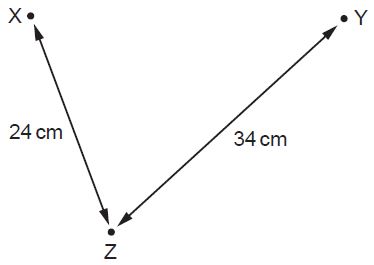
Wave generators at points X and Y produce water waves of the same wavelength. At point Z, the
waves from X have the same amplitude as the waves from Y. Distances XZ and YZ are as
shown.


When the wave generators operate in phase, the amplitude of oscillation at Z is zero.
What could be the wavelength of the waves?

A 2 cm
B 3 cm
C 4 cm
D 6 cm

Solution:
Answer: C.

The amplitude of oscillation at Z is zero, so destructive interference occurs at Z and the difference between lengths XZ and YZ must be an odd number of half-wavelengths.

Path difference between XY and YZ = 34 – 24 = 10cm
This path difference must be an odd number of half-wavelengths.

(n + ½) λ = 10cm
Wavelength λ = 10 / (n + 0.5)
Put n = 0, Wavelength λ = 10 / (0 + 0.5) = 20cm 
Put n = 1, Wavelength λ = 10 / (1 + 0.5) = 6.67cm
Put n = 2, Wavelength λ = 10 / (2 + 0.5) = 4cm [C is correct]
Put n = 3, Wavelength λ = 10 / (3 + 0.5) = 2.86cm
 

Reference: PYQ - May/Jun 2015 Paper 13 Q29

9702/Oct Nov/11/2014/Q27

A diffraction grating experiment is set up using yellow light of wavelength 600 nm. The grating has
a slit separation of 2.00 μm.


What is the angular separation (θ2 – θ1) between the first and second order maxima of the yellow
light?

A 17.5°
B 19.4°
C 36.9°
D 54.3°

Solution:
Answer: B.

For a diffraction grating: d sinθ = nλ
Wavelength λ = 600nm = 600×10-9 m
Slit separation d = 2.00 μm = 2.0×10⁻⁶ m

Angle θn = sin-1 (nλ / d)
When n = 1, θ1 = sin-1 ({600×10-9} / {2.0×10⁻⁶}) = 17.458°
When n = 2, θ2 = sin-1 (2 × {600×10-9} / {2.0×10⁻⁶}) = 36.870°

Angular separation (θ2 – θ1) = 36.870 – 17.458 = 19.4°

Reference: PYQ - Oct/Nov 2014 Paper 11 Q27

Monday, November 5, 2018

9702/May Jun/11/2015/Q26


A wave of amplitude a has an intensity of 3.0 Wm–2.
What is the intensity of a wave of the same frequency that has an amplitude 2a?
A 4.2 Wm-2
B 6.0 Wm–2
C 9.0 Wm–2
D 12 Wm–2


Solution:
Answer: D.

Intensity is directly proportional to the square of the amplitude.
I = ka2
3 Wm-2 = ka2
x = k(2a)2
x = 12ka2 / ka2
   = 12Wm-2

Reference: PYQ - May/Jun 2015 Paper 11 Q26