(i) length,
(ii) pressure.
(b) A relay is sometimes used as the output of a sensing circuit.
The output of a particular sensing circuit is either + 2 V or – 2 V.
On Fig. 10.1, draw symbols for a relay and any other necessary component so that the
external circuit is switched on only when the output from the sensing circuit is + 2 V.

Solution:
(a)
(i) Strain gauge
(ii) Piezo-electric / quartz crystal / transducer
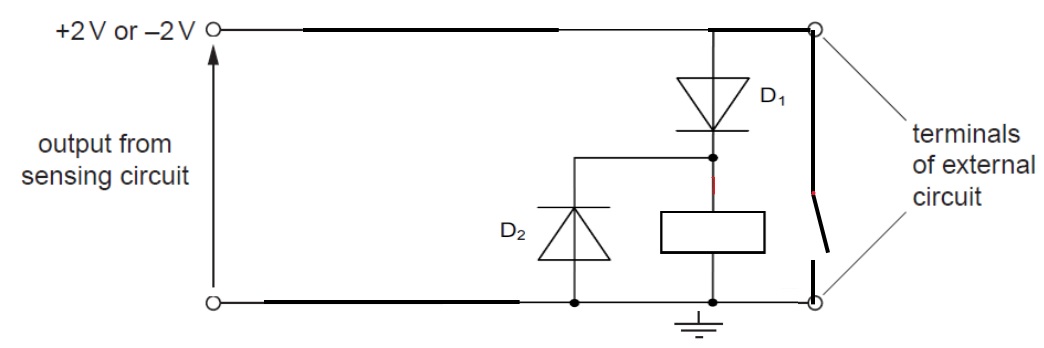
(b) For the circuit, a coil of relay is connected between the sensing circuit output and earth and the switch is across the terminals of the external circuit.
A diode is connected in series with the coil with a correct polarity for the diode (downwards). A second diode with correct polarity is connected (upwards and parallel to coil of relay).
{Note that the following explanations have been taken directly from the application booklet.
The diode D1 conducts only when the output is positive with respect to earth and thus the relay coil is energized only when the output is positive. When the current in the relay coil is switched off, a back e.m.f. is generated in the coil that could damage the sensing circuit. A diode D2 is connected across the coil to protect the sensing circuit from this back e.m.f.}
Reference: PYQ - May/June 2010 Paper 42 Q10
Reference links:
https://electronics.stackexchange.com/questions/100134/why-is-there-a-diode-connected-in-parallel-to-a-relay-coilhttps://electronics.stackexchange.com/questions/56322/do-i-need-a-flyback-diode-with-an-automotive-relay/56323#56323