The diagram shows an experiment to measure the speed of a small ball falling at constant speed
through a clear liquid in a glass tube.
There are two marks on the tube. The top mark is positioned at 115 ± 1 mm on the adjacent rule
and the lower mark at 385 ± 1 mm. The ball passes the top mark at 1.50 ± 0.02 s and passes the
lower mark at 3.50 ± 0.02 s.
The c
onstant speed of the ball is calculated by (385 – 115) / (3.50 – 1.50) = 270 / 2.00 = 135 mms-1.
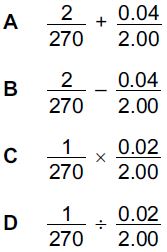
Which expression calculates fractional uncertainty in the value of this speed?
Solution:
Answer: A
Speed v = Distance s / Time t
Δv / v = (Δs / s) + (Δt / t)
Fractional uncertainty of speed = Δv / v
Distance s = 385 – 115 = 270 mm
Δs = ± (1 + 1) = ± 2 mm
Time t = 3.50 – 1.50 = 2.00s
Δt = ± (0.02 + 0.02) = ± 0.04 s
Reference: PYQ - May/Jun 2011 Paper 11 Q5