Showing posts with label MJ2015/13. Show all posts

Tuesday, November 6, 2018

9702/May Jun/13/2015/Q16

The diagrams represent systems of coplanar forces acting at a point. The lengths of the force
vectors represent the magnitudes of the forces.

Which system of forces is in equilibrium?


Solution:
Answer: A.

For the forces to be in equilibrium, the resultant horizontal and vertical components of the force vectors should be zero.

The lengths of the vectors represent the magnitudes. Note that the diagonal vectors in the diagrams will have vertical and horizontal components less than the magnitude of the diagonal vector itself {this is obvious since the diagonal vector and its components form a right-angled triangle with the diagonal vector as the hypotenuse. The hypotenuse has the longest length in a right-angled triangle}.

Therefore, in these diagrams, the horizontal and vertical components of the diagonal vectors should be equal in length (and opposite in direction) as the horizontal and vertical vectors already given.

Diagram A:
The horizontal and vertical components of the diagonal vector are equal in magnitude and opposite in direction to the respective vectors already given. So, in diagram A, the system of forces is in equilibrium.

Diagram B:
The sum of the upward vertical components of the 2 diagonal vectors is greater than the downward vertical vector already present. So, the system of forces is not in equilibrium.

Diagram C:
The sum of the horizontal components (toward the left) of the 2 diagonal vectors is smaller than the horizontal vector (toward the right) already present. So, the system of forces is not in equilibrium.

Diagram D:
The system is not balanced vertically since the downward vertical component of one of the diagonal vectors is greater than the upward vertical component of the other diagonal vector.

Reference: PYQ - May/Jun 2015 Paper 13 Q16

9702/May Jun/13/2015/Q19

When a horizontal force F is applied to a frictionless trolley over a distance s, the kinetic energy
of the trolley changes from 4.0 J to 8.0 J.

If a force of 2F is applied to the trolley over a distance of 2s, what will the original kinetic energy
of 4.0 J become?

A 16 J
B 20 J
C 32 J
D 64 J

Solution:
Answer: B.

Initial kinetic energy of trolley = 4J

Consider the 1st case.
We need to consider the initial 4J here.
Final kinetic energy = 8J
Work done by force F (= Fs) = 8 – 4 = 4J
So, Fs = 4J

Consider the 2nd case.
Work done by force 2F = (2F) (2s) = 4(Fs) = 4(4) = 16J since Fs = 4J

Total kinetic energy = 4 + 16 = 20J

Reference: PYQ - May/Jun 2015 Paper 13 Q19

9702/May Jun/13/2015/Q18


A loaded aeroplane has a total mass of 1.2 ×10⁵ kg while climbing after take-off. It climbs at an angle of 23°to the horizontal with a speed of 50 m s–1. What is the rate at which it is gaining potential energy at this time?


A.            2.3 × 10⁶ J s–1
B.            2.5 × 10⁶ J s–1
C.            2.3 × 10⁷ J s–1
D.            2.5 × 10⁷ J s–1


Solution:
Answer: C.

sin 23o = y/50

y = 50 sin 23o
    = 19.54 ms-1
Use v2 = u2 + 2as to find the h
19.542 = 0 + 2 (9.81) S
S = 19.46 m
P.E. = mgh
        = (1.2 x 10⁵ )(9.81)(19.46)
         = 2.29 x 10⁷ Js-1

Reference: PYQ - May/Jun 2015 Paper 13 Q18

9702/May Jun/13/2015/Q21

A W-shaped tube contains two amounts of mercury, each open to the atmosphere. Air at
pressure P is trapped in between them. The diagram shows two vertical distances x and y.


Atmospheric pressure is equal to the pressure that would be exerted by a column of mercury of
height 760 mm. The pressure P is expressed in this way.

Which values of x, y and P are possible?


Solution:
Answer: B.

This is a relatively complex situation.

Atmosphere pressure PA = column of mercury of height 760mm

Compare the left part of the diagram with the middle (left) part.
Since the position of the mercury column is lower at the middle, the pressure P is greater than the atmospheric pressure acting at the left ‘open’ tube.
P – PA = x
P – 760 = x                              (1)

Now, compare the right part of the diagram with the middle (right) part.
P – PA = 50 – y
P – 760 = 50 – y
P + y = 810                             (2)

The values form the table should satisfy both equation (1) and (2).
Choice A:
Put x = 20 and P = 780 in eqn (1): 780 – 760 = 20    [correct]
Put y = 20 and P = 780 in eqn (2): 780 + 20 = 810    [incorrect]

Choice B:
Put x = 20 and P = 780 in eqn (1): 780 – 760 = 20    [correct]
Put y = 30 and P = 780 in eqn (2): 780 + 30 = 810    [correct]

Choice C:
Put x = 30 and P = 810 in eqn (2): 810 – 760 = 30    [incorrect]

Choice D:
Put x = 30 and P = 790 in eqn (1): 790 – 760 = 30    [correct]
Put y = 30 and P = 790 in eqn (2): 790 + 30 = 810    [incorrect]

Reference: PYQ - May/Jun 2015 Paper 13 Q21

9702/May Jun/13/2015/Q23

The graph shows the non-linear force-extension curve for a wire made from a new composite
material.


What could be the value of the strain energy stored in the wire when it is stretched elastically to
point P?

A 0.09 J
B 0.10 J
C 0.11 J
D 0.20 J

Solution:
Answer: C.

The strain energy is given by the area under the force-extension curve.

Consider a straight line joining point (0, 0) and point P (2.0, 100). This line would be below the curve shown in the question.

For the linear force-extension curve (drawn joining point (0, 0) to point P),
Strain energy = ½ Fx = ½ (100)(2x10⁻³) = 0.1J.

But the shape of graph implies that the area of under the curve shown in the question should be greater than the area calculated. [A and B are incorrect]

However, the answer should be about 10% greater than this straight line graph value to account for the difference. Choice D (0.20 J) is twice the value calculated. This is too big. [D is incorrect]

Reference: PYQ - May/Jun 2015 Paper 13 Q23

9702/May Jun/13/2015/Q29

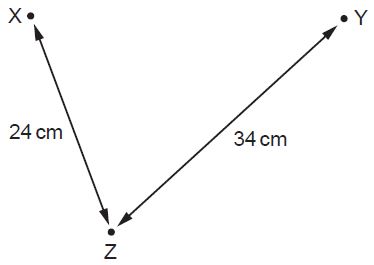
Wave generators at points X and Y produce water waves of the same wavelength. At point Z, the
waves from X have the same amplitude as the waves from Y. Distances XZ and YZ are as
shown.


When the wave generators operate in phase, the amplitude of oscillation at Z is zero.
What could be the wavelength of the waves?

A 2 cm
B 3 cm
C 4 cm
D 6 cm

Solution:
Answer: C.

The amplitude of oscillation at Z is zero, so destructive interference occurs at Z and the difference between lengths XZ and YZ must be an odd number of half-wavelengths.

Path difference between XY and YZ = 34 – 24 = 10cm
This path difference must be an odd number of half-wavelengths.

(n + ½) λ = 10cm
Wavelength λ = 10 / (n + 0.5)
Put n = 0, Wavelength λ = 10 / (0 + 0.5) = 20cm 
Put n = 1, Wavelength λ = 10 / (1 + 0.5) = 6.67cm
Put n = 2, Wavelength λ = 10 / (2 + 0.5) = 4cm [C is correct]
Put n = 3, Wavelength λ = 10 / (3 + 0.5) = 2.86cm
 

Reference: PYQ - May/Jun 2015 Paper 13 Q29