Monday, July 22, 2019
9702/May June/4/2003/Q1
(a) Define gravitational potential.
(b) Explain why values of gravitational potential near to an isolated mass are all negative.
(c) Earth may be assumed to be an isolated sphere of radius 6.4 × 10³ km with its mass of 6.0 × 1024 kg concentrated at its centre. An object is projected vertically from the surface of the Earth so that it reaches an altitude of 1.3 × 10⁴ km.
Calculate, for this object,
(i) change in gravitational potential,
(ii) speed of projection from the Earth’s surface, assuming air resistance is negligible.
(d) Suggest why the equation
v2 = u2 + 2as
is not appropriate for calculation in (c)(ii).
Solution:
(a) Gravitational potential (at a point) is defined as the work done in bringing/moving unit mass from infinity to the point.
(b) The potential at infinity is defined as being zero. The forces are always attractive, so work got out in moving to point (work is done on the mass when moving it to infinity).
(c)(i)
Gravitational potential, φ = - GM / R = - GM × (1/R)
{The distances should be converted in metre. Initial position is at the surface of the Earth, which is a distance of 6.4×10⁶m from the centre of the Earth. The final distance is 1.3×10⁷m (altitude = distance above surface) + 6.4×10⁶m (distance of surface of the centre) = 1.94×10⁷m}
Change in potential = (6.67×10⁻¹¹) (6.0×1024) × ({6.4×10⁶}-1 – {1.94×10⁷}-1)
Change in potential = 4.19 × 10⁷ J kg-1 (ignore sign)
(ii)
The kinetic energy is converted to gravitational potential energy as the height of the object from the surface of the Earth increases.
½ mv2 = mΔφ
v2 = 2 × 4.19×107 = 8.38 × 10⁷
Speed v = 9150 m s-1
(d) The acceleration is not constant.
Reference: Past Exam Paper – June 2003 Paper 4 Q1
Tuesday, July 9, 2019
9702/Oct Nov/11/2010/Q13
A rigid L-shaped lever arm is pivoted at point P.
Three forces act on the lever arm, as shown in the diagram.
What is the magnitude of the resultant moment of these forces about point P?
A 15 N m
B 20 N m
C 35 N m
D 75 N m
Answer: A.
We need to consider which forces will cause a clockwise moment and which cause an anticlockwise moment, that is consider how the lever would rotate about P due to each force.
Clockwise moment is caused by the 5N upward and 10N horizontal forces.
Anticlockwise moment is caused by the 15N downward force.
As for the distances, we need to consider the perpendicular distances from the line of action of the forces from point P.
Perpendicular distance of 5N force: (3m + 1m) – 2m = 2m
Perpendicular distance of 10N force: 2m
Perpendicular distance of 15N force: 3m
Magnitude of resultant moment = Anticlockwise moment – Clockwise moment
Magnitude of resultant moment = (15 × 3) – [(10 × 2) + (5 × 2)] = 15 N m
Reference: PYQ - Oct/Nov 2010 Paper 11 Q13
Friday, April 5, 2019
Electric Fields tough question 1 (From Note)
In a
simplified model, a uranium nucleus is a sphere of radius 8.0 × 10⁻¹⁵ m.
The nucleus contains 92 protons (and rather more neutrons). The charge on a
proton is 1.6 × 10⁻¹⁹ C. It can be assumed that the charge of these protons acts as if it were all concentrated at the centre of the nucleus.
The nucleus releases an α particle containing two protons (and two neutrons) at
the surface of the nucleus. Calculate
a) the
electric field strength at the surface of the nucleus before emission of the
α-particle,
b) the
electric force on the α-particle at the surface of the nucleus,
c) the
electric potential at the surface of the nucleus before emission of the
α-particle,
d) the
electric potential energy of the α-particle when it is at the surface of the
nucleus.
Solution:
Wednesday, March 20, 2019
9702/May Jun/42/2010/Q10
(a) State the name of an electrical sensing device that will respond to changes in
(i) length,
(ii) pressure.
(b) A relay is sometimes used as the output of a sensing circuit.
The output of a particular sensing circuit is either + 2 V or – 2 V.
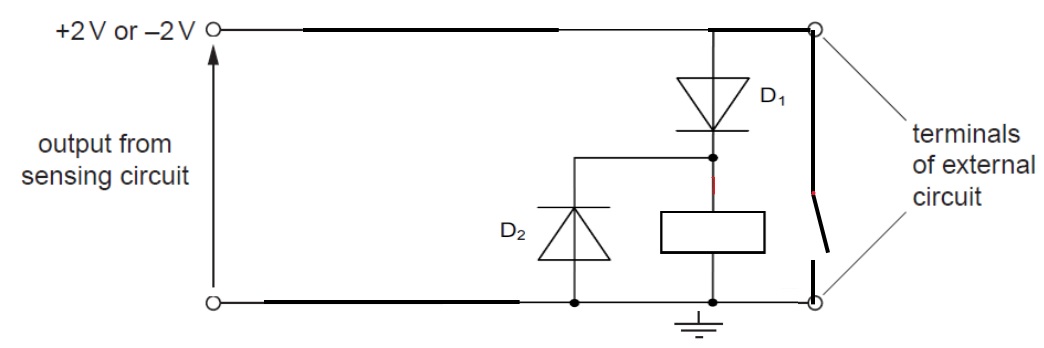
On Fig. 10.1, draw symbols for a relay and any other necessary component so that the
external circuit is switched on only when the output from the sensing circuit is + 2 V.
Solution:
Reference: PYQ - May/June 2010 Paper 42 Q10
https://electronics.stackexchange.com/questions/56322/do-i-need-a-flyback-diode-with-an-automotive-relay/56323#56323
(i) length,
(ii) pressure.
(b) A relay is sometimes used as the output of a sensing circuit.
The output of a particular sensing circuit is either + 2 V or – 2 V.
On Fig. 10.1, draw symbols for a relay and any other necessary component so that the
external circuit is switched on only when the output from the sensing circuit is + 2 V.
Solution:
(a)
(i) Strain gauge
(ii) Piezo-electric / quartz crystal / transducer
(b) For the circuit, a coil of relay is connected between the sensing circuit output and earth and the switch is across the terminals of the external circuit.
A diode is connected in series with the coil with a correct polarity for the diode (downwards). A second diode with correct polarity is connected (upwards and parallel to coil of relay).
{Note that the following explanations have been taken directly from the application booklet.
The diode D1 conducts only when the output is positive with respect to earth and thus the relay coil is energized only when the output is positive. When the current in the relay coil is switched off, a back e.m.f. is generated in the coil that could damage the sensing circuit. A diode D2 is connected across the coil to protect the sensing circuit from this back e.m.f.}
Reference: PYQ - May/June 2010 Paper 42 Q10
Reference links:
https://electronics.stackexchange.com/questions/100134/why-is-there-a-diode-connected-in-parallel-to-a-relay-coilhttps://electronics.stackexchange.com/questions/56322/do-i-need-a-flyback-diode-with-an-automotive-relay/56323#56323
Thursday, March 14, 2019
Capacitor Question 3
(a) A 470 μF capacitor is connected to a 20 V supply. Calculate the charge stored on one plate of the capacitor.
(b) The capacitor in a is now disconnected from the supply and connected to an uncharged 470 μF capacitor.
(i) Explain why the capacitors are in parallel, rather than series, and why the total charge stored by the combination must be the same as the answer to (a).
(ii) Calculate the capacitance of the combination.
(iii) Calculate the potential difference across each capacitor.
(iv) Calculate the charge stored on one plate of each capacitor.
1Q = 20V
(b) The capacitor in a is now disconnected from the supply and connected to an uncharged 470 μF capacitor.
(i) Explain why the capacitors are in parallel, rather than series, and why the total charge stored by the combination must be the same as the answer to (a).
(ii) Calculate the capacitance of the combination.
(iii) Calculate the potential difference across each capacitor.
(iv) Calculate the charge stored on one plate of each capacitor.
Solution:
a)
Q = CV
= (470 x 10^-6) x (20)
= 9.4 mC
bi)
When capacitors are connected in series, the total capacitance is less than any one of the series capacitors’ individual capacitances. If two or more capacitors are connected in series, the overall effect is that of a single (equivalent) capacitor having the sum total of the plate spacings of the individual capacitors. As we’ve just seen, an increase in plate spacing, with all other factors unchanged, results in decreased capacitance.
When capacitors are connected in parallel, the total capacitance is the sum of the individual capacitors’ capacitances. If two or more capacitors are connected in parallel, the overall effect is that of a single equivalent capacitor having the sum total of the plate areas of the individual capacitors. As we’ve just seen, an increase in plate area, with all other factors unchanged, results in increased capacitance.
The total charge stored by the combination must be the same as the answer to (a) is because the total charge of a capacitor is equal to the total charge of both capacitors.
bii)
C = C1 + C2
= 470 uF + 470 uF
= 940 uF
biii)
Q ∝ V1Q = 20V
0.5Q = 10V
biv)
Q1 = (C1) (V)
= (470 uF)(10)
= 4.7 mC
Q2 = (C1) (V)
= (470 uF)(10)
= 4.7 mC
Reference:
Monday, March 11, 2019
Electric Fields Tough Question 1
Two +30 μC charges are placed on a straight line 0.40 m apart. A +0.5 μC charge is to be moved a distance of 0.10 m along the line from a point midway between the charges. How much work must be done?
Solution:
Solution:
Subscribe to:
Posts (Atom)